publications
Peer-reviewed articles, work under review, and work in progress.
Under review & revise-and-resubmit
- Socioeconomic status, maternal age and the risk of stillbirth in the Netherlands (with Selin Köksal and Katya Ivanova). Revise & resubmit, Epidemiology.
- Speed of population change and migration flows in Europe at the sub-national level (with Francesco Billari, Danilo Bolano and Chiara Serra). Under review.
- Stratification in separation: a risk and vulnerability perspective (with Juho Härkönen, Lewis Anderson and Thomas Leopold). Under review.
Work in progress
- Pregnancy loss and partnership survival in the UK and Germany (with Zafer Büyükkeçeci).
- Pregnancy loss following in-utero exposure to job loss (with Selin Köksal and Katya Ivanova), Dutch register data.
- The urban transition of Italian municipalities: connectivity (with Danilo Bolano, Daniela Ghio and Francesco Billari).
- The institutionalization of stepfamilies: union stability across 15 countries.
Peer-reviewed publications
2026
- Soc. Sci. Res.
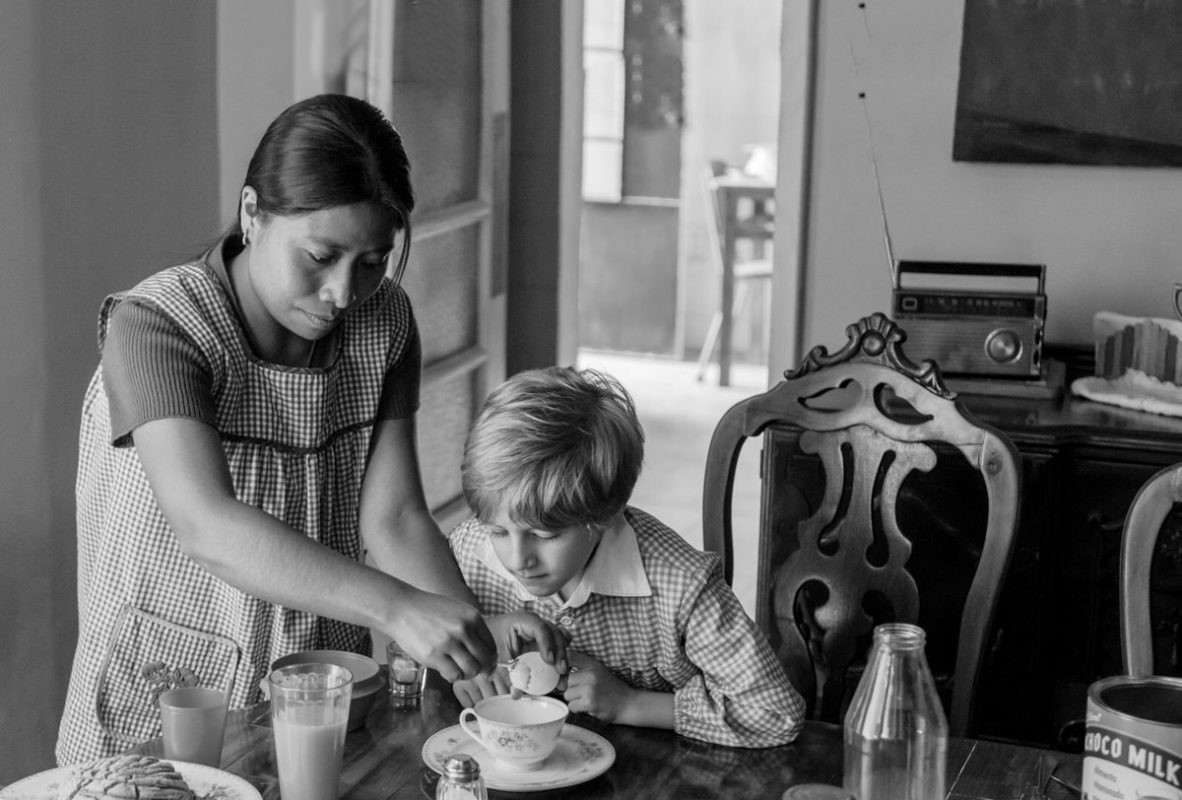 Roma (2018), dir. Alfonso CuarónWomen’s job market outcomes around live births and pregnancy lossesSocial Science Research, 2026What happens to women’s working lives after a pregnancy loss? Following women in the UK from before their first pregnancy to more than five years after it, I find that a loss is followed by an hourly wage about 6 to 7% lower in the first year, and by employment, hours and earnings that decline from the second year onwards. Women who have a live birth show the well-known child penalty, immediate and lasting; a pregnancy loss carries labour-market costs of its own, on a different timetable.
- Env. Res.Per- and polyfluoroalkyl substances (PFAS) and miscarriage: The Norwegian Mother, Father and Child Cohort studyEnvironmental Research, 2026A nested case–control study in the Norwegian MoBa cohort: no clear association between maternal PFAS levels and miscarriage.
2025
- DemRes
 Juno (2007), dir. Jason ReitmanThe partnership context of first parenthoodDemographic Research, 2025When, and in which partnership, do people in the UK have their first child? Following individuals from their teens into adulthood, I show that those from working-class families become parents earlier and more often outside marriage, most often within cohabitation, while those from higher-class families delay parenthood and tend to have their first child within marriage. Cohabiting first births have become more common across all groups over successive cohorts, yet the class gradient in the timing and context of first parenthood persists.
- Demography
 The Way We Were (1973), dir. Sydney PollackSleeping with the enemy. Partners’ heterogamy by political preferences and union dissolutionDemography, 2025Do partners with opposing political views stay together? Drawing on nearly 29,000 British couples between 1991 and 2019, we find that political heterogamy is associated with a higher risk of union dissolution, an association that grew more visible around the Brexit referendum. The pattern suggests that political differences can erode relationship stability much like other forms of value mismatch, and that a polarised climate can make those differences harder to bridge.
- JFEIHow perceived job insecurity, voluntary unemployment and involuntary job loss shape couples’ life satisfactionJournal of Family and Economic Issues, 2025Employment shocks are not all alike. Using German panel data, we compare how perceived job insecurity, voluntary unemployment and involuntary job loss each shape the life satisfaction of both partners, and find that the sharpest declines follow involuntary job loss. Both partners’ well-being responds, not only that of the person who loses the job, underscoring that employment shocks are experienced at the level of the couple rather than the individual.
- PDR
 Pieces of a Woman (2020), dir. Kornél MundruczóCouples’ Subjective Well-being around Live Birth and Pregnancy LossPopulation and Development Review, 2025The gendered emotional responses of both partners around live births and pregnancy losses.
- EJPH
 Raining Stones (1993), dir. Ken LoachWomen’s physical health around live births and pregnancy lossesEuropean Journal of Public Health, 2025How does the body fare around a pregnancy? Tracking women’s physical health over time, I find a decline around births that is more pronounced, and slower to recover, among women who experienced a miscarriage or a stillbirth. The results point to pregnancy loss as an under-recognised marker of women’s longer-term physical health, not only of their emotional well-being.
2024
- SERJob separation and well-being in couples’ perspective in the United KingdomSocio-Economic Review, 2024Involuntary, unexpected job loss harms the well-being of workers and their partners alike.
2023
- Hum. Reprod.Job loss during pregnancy and the risk of miscarriage and stillbirthHuman Reproduction, 2023Job loss during pregnancy nearly doubles the risk of pregnancy loss.
- JMF
 Two Days, One Night (2014), dir. Jean-Pierre & Luc DardenneHow much his or her job loss influences fertility. A couple approachJournal of Marriage and Family, 2023Does losing a job change a couple’s plans to have children? Using UK and German longitudinal data, we find that unions hit by job loss, and especially by the woman’s, are markedly less likely to go on to have a child. The effect concentrates in the years right after the job loss, consistent with couples postponing childbearing when economic security is threatened.
- EJP
 Kramer vs. Kramer (1979), dir. Robert BentonThe intergenerational transmission of family dissolutionEuropean Journal of Population, 2023Is divorce inherited? Using British cohort data, we show that parental union dissolution raises the chance that children’s own partnerships dissolve, and that this intergenerational transmission is conditioned by social-class origin. Children from more advantaged backgrounds are partly buffered, so the reproduction of family instability is stratified rather than uniform.
- Pop. Studies
 The Florida Project (2017), dir. Sean BakerRepartnering of women in the USA: The interplay between motherhood and socioeconomic statusPopulation Studies, 2023After a break-up, who finds a new partner? Analysing US women, we find that motherhood substantially lowers the chances of repartnering for the low-educated, while it matters far less for the highly educated. For less-educated mothers, the combined demands of single parenthood and scarcer economic resources appear to narrow the opportunities to form a new union.
2022
- JMFThe effect of unemployment on couples separating in Germany and the UKJournal of Marriage and Family, 2022Unemployment nearly doubles the annual separation rate of couples in Germany and the UK.
2021
- ESRNo Stratified Effect of Unemployment on IncomesEuropean Sociological Review, 2021After unemployment, income losses are cushioned similarly across social classes in the UK and Switzerland.
2019
- JMFGender Gap in Repartnering: The Role of Parental Status and Custodial ArrangementsJournal of Marriage and Family, 2019Mothers repartner at a lower rate than fathers, a gap shaped by custodial arrangements.